| Next revision | Previous revision |
| lref:land_reform [2025/12/05 10:36] – created - external edit 127.0.0.1 | lref:land_reform [2026/09/09 16:33] (current) – [How it could be] Katja Durrani |
|---|
| # Land reform | This topic is part of [[gt:gardening|Gardening, smallholding & farming]]. |
| | ====== Land reform ====== |
| |
| |
| --- | --- |
| |
| > _"Access to land is not simply a threat to landowning élites — it is a threat to the religion of unlimited economic growth and the power structure that depends upon it." - from the manifesto of The Land Magazine_ | _"Access to land is not simply a threat to landowning élites — it is a threat to the religion of unlimited economic growth and the power structure that depends upon it."_ - from the manifesto of The Land Magazine |
| |
| |
| |
| ## What is land reform? | ===== What is land reform? ===== |
| ### The current situation | ==== The current situation ==== |
| |
| In the 20th century there was a massive transfer of people from the countryside to cities. It happened all over the world, and now for the first time in human history the urban population is larger than the rural population. The transfer has meant the loss of small farms and the rural skills that go with them - blacksmithing, basketmaking, natural building, animal husbandry, spinning, thatching, scything, leatherwork, herbal medicines etc. They've been replaced by industrial agriculture and urban, corporate jobs that suck money out of local communities to pay distant shareholders. In the West, the countryside is becoming a commuter / holiday home / retirement belt. Ordinary people are being kept off the land, because so few people own so much of it, and because the [planning](/plan/planning) system prevents people from building a home on a few acres and becoming independent of the corporate system. It also promotes large farms at the expense of smallholders - for example, to be able to put up agricultural buildings without planning permission, you need to farm at least 5 hectares. | In the 20th century there was a massive transfer of people from the countryside to cities. It happened all over the world, and now for the first time in human history the urban population is larger than the rural population. The transfer has meant the loss of small farms and the rural skills that go with them - blacksmithing, basketmaking, natural building, animal husbandry, spinning, thatching, scything, leatherwork, herbal medicines etc. They've been replaced by industrial agriculture and urban, corporate jobs that suck money out of local communities to pay distant shareholders. In the West, the countryside is becoming a commuter / holiday home / retirement belt. Ordinary people are being kept off the land, because so few people own so much of it, and because the [planning](/plan/planning) system prevents people from building a home on a few acres and becoming independent of the corporate system. It also promotes large farms at the expense of smallholders - for example, to be able to put up agricultural buildings without planning permission, you need to farm at least 5 hectares. |
|  |  |
| <caption> | <caption> |
| Land is the ultimate zero-sum game. If some people have too much, others can't have any. Ted Turner, for example, has 2 million acres. We think that's too much. | _Land is the ultimate zero-sum game. If some people have too much, others can't have any. Ted Turner, for example, has 2 million acres. We think that's too much._ |
| </caption> | </caption> |
| </figure> | </figure> |
| |
| |
| ### History | ==== History ==== |
| |
| In England, the first thing that William the Conqueror did after his victory in 1066 was to claim all the land for the crown. Huge areas were appropriated (which involved the killing of hundreds of thousands of Saxons) and given to his barons as the first feudal estates. Those huge duchies still exist, and many families are proud of their link with this bloody land grab. There was enough common land, however, for peasants to graze their animals, hunt, collect firewood etc. From the 14th to the 19th century, this common land was [enclosed](http://www.thelandmagazine.org.uk/articles/short-history-enclosure-britain) as big landowners grabbed more land and put fences and hedges around it to keep peasants off; and the [Black Act](http://en.wikipedia.org/wiki/Black_Act) of 1723 made poaching on enclosed land a hanging offence. There were various revolts against this trend (including the [Levellers](http://en.wikipedia.org/wiki/Levellers) and the [Diggers](http://en.wikipedia.org/wiki/Diggers)) that didn't end well. | In England, the first thing that William the Conqueror did after his victory in 1066 was to claim all the land for the crown. Huge areas were appropriated (which involved the killing of hundreds of thousands of Saxons) and given to his barons as the first feudal estates. Those huge duchies still exist, and many families are proud of their link with this bloody land grab. There was enough common land, however, for peasants to graze their animals, hunt, collect firewood etc. From the 14th to the 19th century, this common land was [enclosed](http://www.thelandmagazine.org.uk/articles/short-history-enclosure-britain) as big landowners grabbed more land and put fences and hedges around it to keep peasants off; and the [Black Act](http://en.wikipedia.org/wiki/Black_Act) of 1723 made poaching on enclosed land a hanging offence. There were various revolts against this trend (including the [Levellers](http://en.wikipedia.org/wiki/Levellers) and the [Diggers](http://en.wikipedia.org/wiki/Diggers)) that didn't end well. |
|  |  |
| <caption> | <caption> |
| If you think this way of 'farming' is healthy for ecology or for people, you'll love the Green Revolution. | _If you think this way of 'farming' is healthy for ecology or for people, you'll love the Green Revolution._ |
| </caption> | </caption> |
| </figure> | </figure> |
| Back in the UK, the [Plotlands](http://www.historyandpolicy.org/policy-papers/papers/the-hidden-history-of-housing) movement that allowed Londoners to escape to the countryside after the war and build a shack/home on a small plot of land, was one of the things that scared the middle and landowning classes into thinking that the working class might colonise the countryside, and the 1947 Town and Country Planning Act was introduced to prevent the urbanisation of the countryside. This was a good idea in the main - to stop the 'urban octopus' from spreading over the entire countryside. So now there is 'development' land, where the building of homes is allowed, but it's expensive, and quickly snapped up by big developers; and there is 'open countryside', where land is much cheaper, but you can't build a home on it. So, for example, smallholders with, say, 5 acres in open countryside, can't build a natural home on their land so that they can be close to their animals and crops - they would have to buy or rent an expensive, bricks and mortar house in a nearby village and commute to and from the land. People who want to live in a low-impact way find themselves in a _Catch 22_ situation. Either they can afford land that they're not allowed to live on, or they're allowed to live on land that they can't afford. | Back in the UK, the [Plotlands](http://www.historyandpolicy.org/policy-papers/papers/the-hidden-history-of-housing) movement that allowed Londoners to escape to the countryside after the war and build a shack/home on a small plot of land, was one of the things that scared the middle and landowning classes into thinking that the working class might colonise the countryside, and the 1947 Town and Country Planning Act was introduced to prevent the urbanisation of the countryside. This was a good idea in the main - to stop the 'urban octopus' from spreading over the entire countryside. So now there is 'development' land, where the building of homes is allowed, but it's expensive, and quickly snapped up by big developers; and there is 'open countryside', where land is much cheaper, but you can't build a home on it. So, for example, smallholders with, say, 5 acres in open countryside, can't build a natural home on their land so that they can be close to their animals and crops - they would have to buy or rent an expensive, bricks and mortar house in a nearby village and commute to and from the land. People who want to live in a low-impact way find themselves in a _Catch 22_ situation. Either they can afford land that they're not allowed to live on, or they're allowed to live on land that they can't afford. |
| |
| ### How it could be | ==== How it could be ==== |
| |
| There are several ways that governments could help to distribute land more fairly. For example, after World War 1 in Eastern Europe, including Finland, a cap was put on the amount of land an individual or family could possess (usually between 20 and 500 hectares). In Scotland today, funding and guidance is being provided to help increase community ownership of land; and a [land value tax](http://en.wikipedia.org/wiki/Land_value_tax) has been proposed since the 19th century, to make the ownership of vast areas of land less financially attractive. | There are several ways that governments could help to distribute land more fairly. For example, after World War 1 in Eastern Europe, including Finland, a cap was put on the amount of land an individual or family could possess (usually between 20 and 500 hectares). In Scotland today, funding and guidance is being provided to help increase community ownership of land; and a [land value tax](http://en.wikipedia.org/wiki/Land_value_tax) has been proposed since the 19th century, to make the ownership of vast areas of land less financially attractive. |
|  |  |
| <caption> | <caption> |
| Supermarkets, identikit housing estates, motorways, pylons, all fine; self-built, natural homes like [this](http://lowimpactorg.onyx-sites.io/we-have-a-huge-housing-problem-and-yet-they-want-to-destroy-charlies-home-you-can-help/ "We have a huge housing problem, and yet they want to destroy Charlie’s home; you can help"), no. With today's housing shortages, it doesn't make sense. | _Supermarkets, identikit housing estates, motorways, pylons, all fine; self-built, natural homes like [this](http://lowimpactorg.onyx-sites.io/we-have-a-huge-housing-problem-and-yet-they-want-to-destroy-charlies-home-you-can-help/ "We have a huge housing problem, and yet they want to destroy Charlie’s home; you can help"), no. With today's housing shortages, it doesn't make sense._ |
| </caption> | </caption> |
| </figure> | </figure> |
| <WRAP center centeralign> | <WRAP center centeralign> |
| <figure> | <figure> |
|  |  |
| <caption> | <caption> |
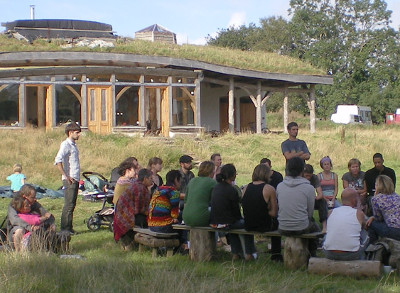
| Members of [Lammas](http://lammas.org.uk/) co-op in Pembrokeshire meet in front of their community hub. | _Members of [Lammas](http://lammas.org.uk/) co-op in Pembrokeshire meet in front of their community hub._ |
| </caption> | </caption> |
| </figure> | </figure> |
| |
| |
| ## What are the benefits of land reform? | ===== What are the benefits of land reform? ===== |
| |
| The problems of sustainable provision of food, housing and energy are, if not solved, at least reduced, depending on how many people take up the offer. Millions of people could potentially apply to live like this if they could be accommodated - and more will be inspired by people already doing it, to gain the skills to do it themselves. Smallholdings produce [more food per acre](http://www.monbiot.com/2008/06/10/small-is-bountiful/) than large farms, plus they can house and employ more people, and strengthen local economies. Below are more benefits: | The problems of sustainable provision of food, housing and energy are, if not solved, at least reduced, depending on how many people take up the offer. Millions of people could potentially apply to live like this if they could be accommodated - and more will be inspired by people already doing it, to gain the skills to do it themselves. Smallholdings produce [more food per acre](http://www.monbiot.com/2008/06/10/small-is-bountiful/) than large farms, plus they can house and employ more people, and strengthen local economies. Below are more benefits: |
|  |  |
| <caption> | <caption> |
| In a pioneering community buyout in 1997, the people of the Isle of Eigg became the first tenants in Scotland to clear a Laird from his estate. | _In a pioneering community buyout in 1997, the people of the Isle of Eigg became the first tenants in Scotland to clear a Laird from his estate._ |
| </caption> | </caption> |
| </figure> | </figure> |
| |
| |
| ## What can I do? | ===== What can I do? ===== |
| |
| You can [read](/lref/land_reform) more on the subject, and/or subscribe to [The Land](/lref/land_reform) magazine. Then there are lots of initiatives out there - you could consider joining / helping them. | You can [read](/lref/land_reform) more on the subject, and/or subscribe to [The Land](/lref/land_reform) magazine. Then there are lots of initiatives out there - you could consider joining / helping them. |
| |
| |
| ## Further resources | ===== Forum ===== |
| |
| | This topic belongs to the section [[gt:gardening|Gardening, smallholding & farming]]. You can ask questions or add information on the corresponding [Forum section](https://forum.growingthecommons.org/t/gardening). |
| |
| | ===== Further resources ===== |
| |
| ## Specialist(s) | - [Landmatch England](https://landmatchengland.org.uk/) - increasing access to land for new entrants, and encouraging regenerative and agroecological practices across England |
| | - [Access to Land](https://www.accesstoland.eu/) - European network of grassroots organisations securing land for agroecological farming |
| | - [The Land is Ours](https://tlio.org.uk/) - land rights campaigning in the UK |
| | - [Ecological Land Co-op](https://ecologicalland.coop/) - helping set up sustainable smallholdings |
| | - [Scottish Crofting Federation](https://www.crofting.org/) - member-led organisation dedicated to promoting crofting and the largest association of small-scale food producers in the UK |
| | - [Via Campesina](https://viacampesina.org/en/) - international peasant movement |
| | |
| | |
| | |
| | |
| | ===== Related topics ===== |
| | |
| | - [Commoning](comg:commoning) |
| | - [Commons economy](coec:commons_economy) |
| | - [Community](comy:community) |
| | - [Community land trusts](clts:community_land_trusts) |
| | - [Community-supported agriculture](csas:community-supported_agriculture) |
| | - [Intentional communities](intc:intentional_communities) |
| | - [Philosophy](phil:philosophy) |
| | - [Planning permission](plan:planning) |
| | - [Small is beautiful](smal:small) |
| | - [Smallholding](smho:smallholding) |
| | - [Tree/woodland management](wodl:woodland_management) |
| | |
| | ===== Specialist curators of this topic ===== |
| |
| |