**This is an old revision of the document!**
This topic is part of Community & culture and Bushcraft & nature.
Social forestry
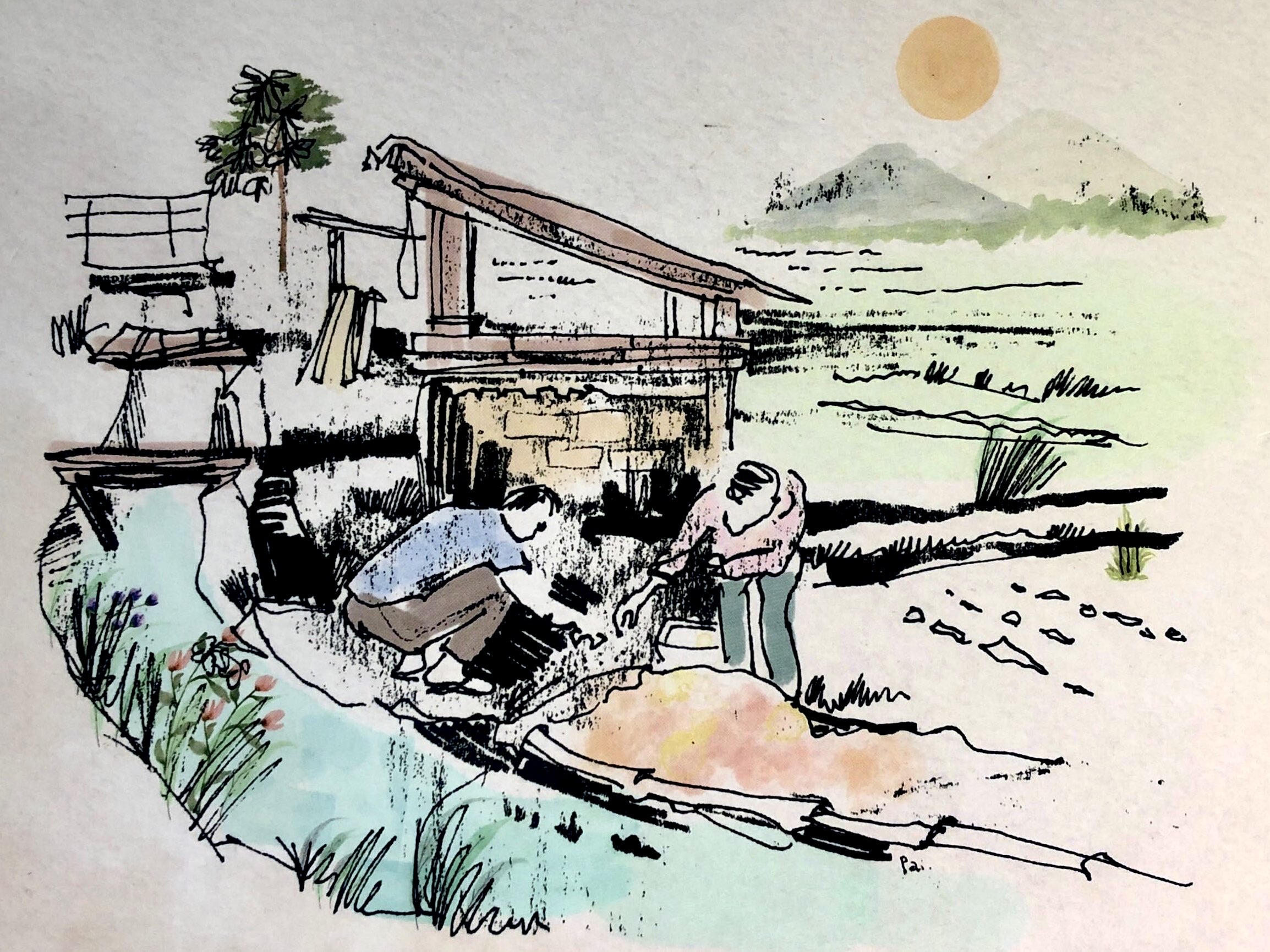
With familiarity and Place-knowledge, we come together in council and accept the ultimate welcome: the restoration of kinship and webs of relations. The deep feelings of belonging, included in council, our membership in complexity.
— Excerpt from the introduction of Social Forestry: Tending the Land as People of Place by Tomi Hazel Vaarde.
What is social forestry?
Social forestry is a collection of both practical skills and philosophical perspectives for the development of inter-species commoning. What does that mean? When we think of community-building, we often mean it in the sense of building relationships between humans. Social forestry extends this circle: how do we build community in a way that has its foundation in the specific environment of that community's land?
Social forestry is best described in the book Social Forestry: Tending the Land as People of Place by Tomi Hazel Vaarde. Here is some information about the Social Forestry book, from the publisher's website. Tomi Hazel Vaarde writes from extensive experience in working pillaged, damaged, colonised land in Turtle Island (the USA).

How do you do social forestry?
A very important part of social forestry is that there cannot and should not be one way to do things, especially the deeper we get into specifics. In the book, Hazel notes that people would often ask for (or demand!) a “prescription”: they wanted to be told what they should be doing! However, the author believes that “prescribing” a specific way of doing things opens up a movement for co-optation by capitalism & colonialism. It is much easier to be an “influencer” selling ideas online if they feel able to remove a technique from its context and deploy it in an entirely different context.
For example, Hazel writes from the experience of working the land in the West of Turtle Island, in a place called Wolf Gulch which is often short on water. The land there is very dry and has developed over hundred of years of prescribed burns (intentionally-set brushfires) from the indigenous people living there. This is not the case everywhere. Consider Northern Europe, where waterlogging and flooding are much bigger concerns, or Central Asia, which has no coastal fog to deliver water.
So, when asking how you do social forestry, the answers will encourage you to explore a process of re-orienting your life, and your community's life, around the land where you live. You will need to get outside and cut branches, harvest plants, observe which trees grow where (and why).

(Some) social forestry principles
Hazel describes some broad principles which are workable in most contexts. This list is not exhaustive.
Foundational ethical and precautionary principles:
- Working Together brings good fortune.
- Drainage Basin Councils build and hold culture that reaches for appropriate local opportunities. (Curator's note: Drainage Basin Councils are communities formed on lands where the water will flow into a shared river, also called a “watershed” or a “river catchment”.)
- Cultural Habits emerge from cooperation with Nature in Place.
- Let the land guide us: we sit in council with All Beings of Place, taking our humble tasks from complex cues.
- There is honour for everyone: All sorts of Humans have skills and propensities that are useful to the common effort. Every gift from the land is appreciated and celebrated.
- We bring Human culture into the forest, and Forest offerings into our homes.
Ecological principles:
- A forest is an intertwined set of relationships anchored on tall woody perennials and stacked from deep roots to leafy crowns with layers of ecology. Save all the parts: we do not know how to assemble one from scratch. We can help forests get started or repaired.
- Forest types are site, aspect, and climate specific. Forests migrate during climate changes. We can only tinker with these dynamics. Pay attention and look for emergent opportunities.
- Nutrient cycles are local and elaborate in forests. This net of mutuality supports heavy carbon and water loads, modifies local climate, and allows maximum biodiversity with complex relationships.
Forestry work principles:
- Perfect timing: become tuned to the land. The shape of Place holds the stories, and we can come into alignment with potential magnification and elaboration.
- Use the right hand tool for the job: sharp, well-tended tools are convivial. We work together safely and expediently while attuned to our culture and surroundings. (Curator's note: Hand tools force you to work at a human pace and engage directly with the environment. Hazel discourages the use of mechanised tools for these reasons.)
- Restoration to what? The regenerated ecosystem functions will not be like any previous regime. Tending changes the Wild dynamics. Humans are implicated in co-evolution. Pay attention and stay nimble. Observe and reflect.
- Work skills are learned from example and honed through practice. Re-skilling is the work of manifesting the basic-hand-skills common to Human cultures but forgotten in modern-industrial-consumerism. We need to get back to muscle and attention knowledge (poise).

Social forestry fundamentals
Legacy trees
A legacy tree is a big, old, hardwood tree, for example, an oak tree. Many of us live in lands that have been very heavily deforested, and we don't have many legacy trees left. It is very important for us to protect and nurture these trees!
Hardwood trees have wide crowns: their branches spread out from the trunk. Rainfall will drip from the edge of the crown, and some of it will also flow down the branches to the trunk, providing water to plants below the tree. These trees are also deciduous, meaning that they shed their leaves in the winter. Since they shed their leaves, plants below the tree can drink in the sunlight in the early spring. This water and sun lets hardwood trees co-exist with shorter plants more than softwood evergreens. Legacy trees will also have more cavities, mistletoe clumps, and tangles, which are important homes for animals. Due to how old they are, they have had time to grow mosses and lichens.
Legacy trees will usually have spread-out crowns This is a growth pattern of a tree that had a lot of space to fill out, meaning they were not crowded in by other trees. They will often be crowded with trees (fast growing conifers, often!) in forests that are “protected” from humans.
Helping a legacy tree provides a place-centred way of orienting our maintenance of the landscape. To help the legacy tree, we can harvest the younger trees on the south side of the legacy tree (as we are in the Northern hemisphere, the sun comes from the South). This can create a clearing for plants like blackberries that don't grow well under trees. We can carefully cut down any trees that grow through the crown of the legacy tree. Then, in the shade, we can thin the forest a bit and use it for growing conifer “poles” out of stumps, but we should suppress new growth too close to the tree.
Legacy trees are an example of human activity being shaped by respect for non-human organisms.

Catchments and guilds
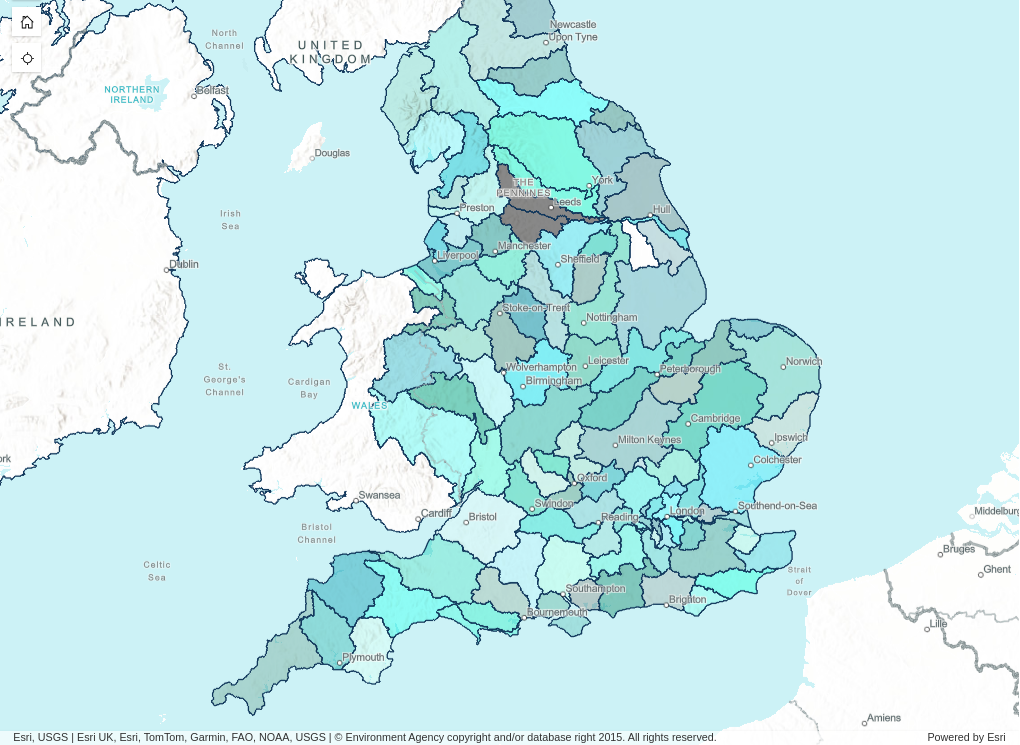
Rivers are like the veins and arteries of our land. They flow across council boundary lines and country borders. Each river is surrounded by a catchment or drainage basin. The catchment is the land where, when rain falls there, it will eventually flow into the river. Anything that happens on a catchment will impact the river. Almost all land in Britain and Ireland is part of a river catchment.
Because rivers are shaped by huge catchments, and because they flow over long distances, rivers and their catchments are natural foundations for human coordination. You cannot care for a river on your own. The health of a river in your specific location is dependent on everything going on over the entire catchment from where you are to the river's source, and what you do to the river or its catchment will impact everything downstream. To manage a catchment, we have to form communities, and these communities have to communicate with each other. Catchments are one of the many things that inform bioregioning.
Social forestry suggests organising tight-knit communities based around skills, called guilds, such as gardeners who maintain land close to habitation, rangers who observe landscapes over a broad-scale, and travelling messengers, entertainers, and/or seasonal workers who exist to spread messages within and between catchments. These groups are united in their shared work and skills, and connected to each other via spokespeople and the travelling guilds. Spokespeople from the guilds organise to work with other local guilds in councils. Travellers link councils together, enabling the whole catchment to maintain connection. Guilds also coordinate with neighbouring guilds of the same type, for example, woodcutters talking to neighbouring woodcutters and finding out important information about a spreading tree disease.
Catchments are an example of human communities being made essential by the realities of a landscape.
Communication and a sense of belonging
Our modern culture isolates people from the land and from each other. Social forestry revolves around tight-knit communities which work in conjunction with other communities. Establishing and maintaining community is difficult. The formation of guilds allows people to unite over shared work, and via the relationship-building act of teaching each other.
Our culture also considers only a limited set of skills worthwhile. Consider concepts such as “employability”. This isolates the disabled, the sick, and those who have skills in other places. Social forestry explicitly demands the inclusion of everyone who is willing to cooperate. Let people settle in slowly, propose their own ideas for things they might do. Ask them questions. What would they like to do? What is stopping them from doing it? Do they understand our shared goals and what needs to be done to achieve them? Never assume!
Another major aspect of social forestry community-building is transparency of expectations and decision-making. Resentment builds when people feel like they cannot express their opinions during discussions, or if they feel they have been socially “de-valued” due to breaching a rule they did not know. Clarity and forgiveness are essential. Did someone break a rule out of malice, or did they not understand the rule or why it is important?

Culture-landscape integration
Many of us live in cultures that are detached from our landscapes. Hazel calls us “Moderns” or “Modern people”. We can buy food from halfway around the planet, and our lives can be transplanted from one location to another with relative ease (as long as you have the money and the immigration documents). This is distinct from cultures that have a strong connection to their land.
An example that Hazel gives is that of the Gaelic celebrations. Imbolc in February is celebrated around the start of lambing season, while Beltane in May marks the start of planting field crops, and Lamas in August marks the start of the harvest. These are cultural nuances developed in a particular landscape and climate. Compare this to, say, Christmas — its wintry-themed decor is more than a little odd for those celebrating during the Australian and South African summer.
How might one establish new practices (or retrofit old ones) that integrate the landscape into our daily lives? That's something to explore. Maybe existing celebrations could have new traditions appended to them, like going and foraging young plants during a springtime celebration. Maybe festivals can be started revolving around a landscape feature, like an “acorn festival” where people help tend to oak trees and collect acorns, and then eat acorn-based treats. Which landscape features would you celebrate? How might you get others to start doing it? Sometimes it can be as simple as just doing it — meeting up with friends somewhere public, making banners to draw attention, and let people join in as they take notice.

Diversity, messiness, and taboo
Social forestry embraces diversity and messiness, as the Wild we interface with is diverse and messy. Categories are useful but are not sacred; deviations and exceptions are natural and should be embraced. In human communities, people may not fit nicely into expected roles — don't force them, find what does suit them and let that passion shine. Modern culture demands a narrow set of competencies and manners of self-expression, resulting in a lot of miserable people who have their skills and passions squandered. No wonder Modern culture produces so many “troublemakers”!
At the same time, taboos are necessary to maintain good social forestry culture. You might know about the paradox of tolerance. We will all carry our own baggage, but we can't let that baggage go unaddressed if it is undermining the community.
It is essential that community members understand what the taboo is, why it exists, and how it is effective at doing its job. Consider the following rule: “No smoking on the bus”. This taboo exists to prevent exposure to secondhand smoke. It is pretty effective, but less so now that there are electronic vapes that people can hide. Some people do not consider it sufficiently important to prevent spreading secondhand smoke, and smoke on the bus anyway. How might the taboo be reworked?

Considering using social forestry techniques
Do any of the above fundamentals stand out to you? Are there any that you already practice, or are there ones that you would want to work towards? How might some of these fundamentals be added to the things that you are doing?
It's worth repeating: social forestry practice is by definition going to look different in every context. It must be adapted to the landscape and its community and their shared history. This will be iterative, and practice will change over time over trial-and-error. Check back with the fundamentals of land-culture integration, diversity, transparency in rule-making and decision-making, and letting the landscape guide the work we do on it. From that seed, a different plant will grow depending on where you plant it.
Links
Related forum section
This topic is part of Community & culture and Bushcraft & nature. You can ask questions or add information on the corresponding Community & Culture and Bushcraft & Nature Forum sections.
Related pages on this site
Further resources on other sites
- The introduction to Social Forestry, published by Resilience.org.
- Information about the Social Forestry book, from the publisher's website.
- Find your catchment, if you are in England.
Curator commentary
Social forestry is an extension out of permaculture; I think it directly addresses some problems with permaculture. Most importantly: social forestry's emphasis on avoiding prescription solutions (and the people who try to sell them to you!) should really be taken to heart for permaculture. There are a lot of permaculture “influencers” trying to sell you books and courses, despite having no idea what landscape you're working on. — Otto Hague 2026/04/20 16:25
Open shared questions
(as collectively agreed)