This topic is part of Bushcraft & Nature.
Wild food foraging

“I would feel more optimistic about a bright future for man if he spent less time proving that he can outwit Nature and more time tasting her sweetness. ” - E. B. White
What is wild food?
Wild food is anything edible that has had no management to increase its production. This subject really also encompasses coastal foraging, wild mushrooms, fishing, crayfish and game, but we've listed these as separate topics; we focus mainly on wild land plants (leaves, berries, fruits, nuts, roots or sap) in this topic.
Wild food was once necessary for human survival, but now most traditional knowledge of wild food has been lost. In recent years there has been a widespread revival in foraging, and you can now do courses all over the UK from the wilds of Scotland to urban centres like London.
Wild food harvesting in Britain and Ireland is mostly done by individual hobbyist foragers. While this is the most straightforward way to integrate wild food into your diet, it might risk over-harvesting, spreading invasive species, or other issues. Foragers can work together in a Wild Food Common, learning from past and present community management of wild food resources.

Many of the plant species that we view as weeds are edible and nutritious - modern farming favours foods that have been cultivated from their wild ancestors. We clear away ‘weeds’ to grow crops, yet many wild plants are more nutritious than their cultivated counterparts. For example the edible wild plant 'fat hen' contains more iron and protein than spinach, and more vitamin B and calcium than cabbage. As with many other wild foods it can also be cooked in the same way as the vegetables we regularly eat. Wild food plants and fungi form a part of the rich diversity of species that is vital to the functioning of ecosystems. Many of these species are being lost due to habitat destruction and pollution. Collecting wild food is much more popular in continental Europe. In one region of Finland 68% of households pick wild fungi for consumption - unimaginable here in Britain.

What are the benefits of wild food?
As long as we are sensitive when collecting wild food and consider other species, harvesting wild food can be beneficial to the environment. Wild food has no packaging, no chemicals to force it to grow, and can be picked local to your area, minimising food miles and pollution from vehicle exhausts.
Picking wild food in moderation can foster appreciation of nature, resulting in greater conservation of species. For example, if we wish to harvest wild garlic every spring, we might be more vocal if it's under threat!
Eating a range of different species maintains biodiversity - the opposite of our intensive farming system, where we grow crops in monocultures, with damaging effects for the environment. Target species are favoured over wild species, and are grown intensively using pesticides, which can have detrimental effects on wildlife. Many of the wild animals that can be eaten are pests that have to be controlled and are often wasted.

One example is the grey squirrel, an introduced species that causes damage to tree saplings in woodlands, and forces out our native red squirrel. If they are to be culled, isn't it better to eat them in preference to animals that may have been fed intensively-grown crops, housed indoors, pumped with antibiotics and transported many miles to reach your plate?
Consuming wild food can instill a greater respect for the environment, reconnecting us to the origins of our food, and illustrating our dependency on nature for survival. It also highlights the importance of seasonality and offers an alternative to our current globalised food system, where we can buy anything at any time of year.

There are health benefits too, as seasonal food matches the body’s needs. For example the spicy peppery leafy greens that arise in spring are good for renewal after the winter, and clean out the digestive tract. Our prehistoric ancestors browsed on wild foods from their local area, gaining the nutrients needed for healthy immune systems. Store-bought food has been bred for transport, appearance, and sweetness, not nutrition, so wild food often contains more nutritional value than store-bought food (Stark et al., 2020) and also poses a lower risk to diabetics. Collecting wild foods is also thought to have a therapeutic value and is a great incentive to enjoy the countryside.
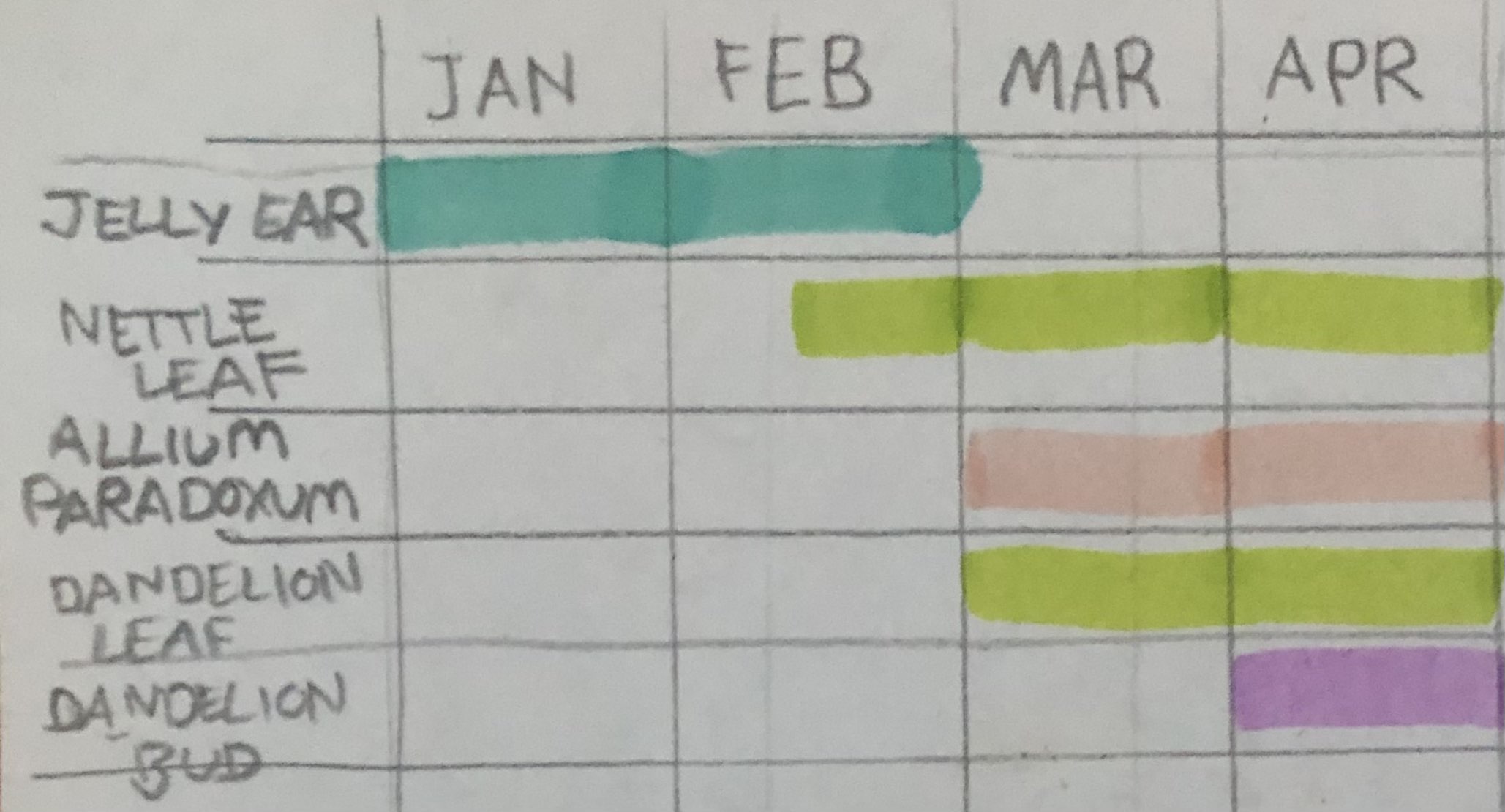
Collecting, processing and eating food from your landscape, in the season it grows, can provide a real sense of connection to the land and time of year. An interesting exercise is to start writing down a personal foraging calendar, based on what wild foods you can find in your area, and when. This will “tune you in” to the changing of the seasons in your specific landscape.
Plus it's free!

What can I do?
Foraging for wild food is exciting, as you never know what you are going to find. Wild plants and fungi grow in many places, even on wasteland in towns. Wild food is not only free but has also grown without us having to do any work.
Learning from someone who knows about wild food is a great start - a mentor or course provider. Being shown the plants in their natural habitat is really helpful when wanting to find and identify them later. Why not ask on our forum if there is someone who can show you the ropes?

Getting a good book or two will really help - especially if you can take them with you when you go out foraging. It can be a good idea to have a field guide and a wild food book - as field guides are often much more accurate for identification, but don't necessarily tell you whether you can eat things. We recommend the Bloomsbury "Concise Foraging Guide" by Tiffany Francis-Baker, and Collins Gem "Food for Free" by Richard Mabey. Don't buy any random book, as nowadays there are LLM-generated "guides" for sale that might well kill you.
Anyone can pick their own wild plants and fungi; however there are some simple principles, and laws, that must be followed, for your own safety, and the preservation of plant populations.
Safe foraging
- Be 100% sure of your plant identification… 'if in doubt, leave it out'. We have some seriously poisonous plants in the UK, so get to know them, as well as getting to know the edible ones.
- Double check the location you are foraging - avoid pesticides or other toxic substances, and foraging beside busy roads (as cars can shed cadmium, lead, and microplastics (Stark et al., 2020). Forage above knee level if close to a trail, unless you want some dog urine in your diet.
- If you are foraging water plants, always cook them - the risk of Liver Fluke and other water-borne illnesses is high in the UK.

Responsible foraging
- Take only what you need and can realistically eat.
- Leave plenty behind. Different people have different proportions they like to leave - always leave some for wildlife and other foragers. If it's out of reach, take that as a hint to leave it.
- Don't pick rare or endangered plants - even if they're in your wild food book! Some species are protected by law. For a list see the Botanical Society of Britain and Ireland.
- Make sure you have permission from the landowner if necessary. It's illegal to dig up a plant without permission. Species must not be picked from a National Nature Reserve (NNR) or Site of Special Scientific Interest (SSSI) without permission.
- Gather plants from healthy, plentiful populations.
- Be aware of where you're treading - be careful of damaging other plants as you reach for the juiciest blackberries! Try to damage the plant you're picking from as little as possible.
There is a philosophical or spiritual angle to foraging, if you would find it useful. Robin Wall Kimmerer is a professor of ecology and a member of the Citizen Potawatomi Nation. In her book Braiding Sweetgrass, she brings up the idea of asking plants for consent: is that blackberry within reach? Does that elderberry cluster overhang a deep river? If you cannot access the forage without trouble (climbing, injuring yourself), the plants are not consenting. Using the concept of plant consent keeps you safe and prevents overharvesting.

If you're a beginner, try picking obvious species that you are already familiar with - for example nettles or dandelions. Just as importantly, familiarise yourself with the poisonous plants in your area too. Never eat any species that you are unsure of. Remember that many species are poisonous and some must be cooked to remove toxins.
Wild Food Commons
We mentioned in the introduction that most wild food harvesting in Britain and Ireland is done by individuals. When the number of people doing this is low, the possibilities of harming the environment is small, but the more people harvest wild food, the more of an impact it has.
For example, wild garlic harvesting is increasingly popular, and some people uproot the plant, making its populations more sparse. At the same time, its habitat is favourable to the invasive garlic, Allium paradoxum, known as the few-flowered leek, which spreads easily by getting stuck in boot treads and dog paws. Foraging for wild garlic might put the plant's population towards being endangered. Take the few-flowered leek instead! It's also edible!
The most responsible way to harvest wild food is to avoid acting individually. Connecting with your community opens up possibilities for educating each other and for management of wild food resources. You may not have known about the few-flowered leek until you read about it just now: we badly need networks to circulate information and responsibilities!

Here are some examples of community management of wild food resources:
Example 1: The cultivated landscapes of Turtle Island
There is an abundance of examples of communally managed landscapes, built for foraging, from Turtle Island (North America). Many communities of First Nations people would burn, cut, and tend the landscape in ways that created food-rich forest-gardens that do not resemble the labour-intensive agriculture of the colonisers. For decades, and even now, this has been misconstrued as First Nations people being “backwards,” and the landscapes of Turtle Island being “untouched wilderness.”
Andy Ciccone of agroecologies.org has written and spoken about many examples of First Nations landscape cultivation. As an example, we will talk about the cultivation of the tekeneipen, or Apios. Apios were foraged and were also purposefully planted along trails and in clearings that would be traversed during hunting, providing an additional boon for hunters and foragers travelling along them. In the Apios article, Ciccone states that the settlements and hunting paths of the First Nations were surrounded by a cornucopia of edible plants: oak, hickory, pawpaws, Apios, and others. The bounty was remarkable enough that the colonisers made note of the fact.
This surrounding bounty was not “untouched wilderness,” but an ecosystem resulting from varying degrees of human management. Food plants (and particularly desirable varieties of each plant) were shared amongst communities and planted at each other's settlements, sharing in the literal fruits of the Earth. This is purposeful cultivation, but distinct from a concept of farming or gardening. Native, useful forage is planted and re-planted to ensure its availability and to have it grow in convenient places, but without the labour costs of growing a vulnerable domesticated plant.

Example 2: Online knowledge sharing with fallingfruit.org
Fallingfruit.org is an online resource where people can drop pins on a map, signifying (urban) food resources. Each pin contains information on the food (species, if it is on private property, etc) and people can leave reviews to corroborate the information. It is a global knowledge-sharing platform, enabling anyone anywhere to let their local community know what food grows where.
While fallingfruit.org is mainly a knowledge-sharing platform, it does have some capacity to reclaim land in common to a minor degree. Public land (government-owned) is opened up as a resource. Additionally, private landowners can either put information on the map themselves, or provide permission for others to do so. While neither truly wrests legal ownership from the government or private landowner, it does provide small inways to these lands and allows a landowner to open up their land on a temporary basis.
I would encourage every private landowner reading this to put their food resources up on fallingfruit.org, to provide permission to their community to walk on their land and pick some of its bounty.
Example 3: “Forestizenship” and the extrativistas in Brazil
Reservas extrativistas (RESEX) are state-owned lands in Brazil where access and use rights are given to predominantly indigenous communities (Pinzón Rueda & Ruiz Murietta, 1995). The communities make their living off these lands through small-scale gardens and extraction of forest resources. Their close, long-term, and often spiritual or moral connections to the forest results in these communities defending the RESEX from encroachment, including to the death, as in the case of the murder of forest-defenders Ze Claudio and Maria do Espírito Santo.
RESEX are structured both by the social and environmental conditions impacting the “interspecies common” (a term used by Barca, 2024) (Brown, 2001). Connectivity to other settlements, family history, encroachment by mining and logging, rainfall, de- and re-forestation, all of these are factors. Within the RESEX, the communities generally create a mosaic of landscapes: pasture, forest, and cultivated plant growth at different stages of maturity (Brown, 2001). The close association of forest and shifting cultivated lands allows fallow land to quickly “re-wild” into yet another participant in the mosaic (Brown, 2001). Remember: this kind of mosaic landscape is an enabler of increased biodiversity!
Moreover, the mature forest provides essential goods to the communities, disincentivising logging (Brown, 2001). The survival of the community and their forest are inextricably linked, enough to cultivate a feeling of florestania, or “forestizenship” (Barca, 2024). This is the kind of deep connection that is enabled by a foraging relationship, and ultimately protects the forest.
Example 4: Thengapalli and the jungle loko in Odisha, India
Singh (2013) describes a community in Odisha, India, that is protecting its forest, even while economic and legal incentives push them in the other direction. The community respects and cares for the forest, and in exchange, foraging is a prominent part of their lives and provides psychological, spiritual, and physical nutrition. Much like the extrativistas of the RESEX, the community considers the forest and the act of caring for the forest as fundamental to their identity. They know themselves by the term jungle loko, “forest people” or jungle-jati, “forest caste.”
Forest-care is a community ritual that strengthens interspecies and intra-community bonds. One component of this care is thengapalli, where the role of patrolling and protecting the forest (thenga, a wooden baton) is passed between families, which take turns (palli) performing the patrol. The duty of thengapalli is shared and rotated, preventing the cementing of a guard-class. In some cases, thengapalli is not needed as the community spends so much time in the forest anyway. Using the forest regularly attunes the community to the forest’s health: what it needs, and what threatens it. Both foraging use and thengapalli represent labour that builds a connection and a sense of simultaneous belonging/ownership.
David Bollier interviewed Singh about her publication on Odisha. If you want to learn more, we would recommend checking that out.

Forum
This topic belongs to the section Bushcraft & Nature. You can ask questions or add information on the corresponding Forum section.
Further resources
- Eat Weeds - blog, videos, podcast and more on wild food
- Galloway Wild Foods - guide, blog and recipes
- Wild Edible - US-based foraging site with good information on safety
- Woodland Trust - foraging: what to look out for every month
- Barca, S. (2024). Workers of the Earth. Pluto Press.
- Brown, I. F. (2001). Extractive Preserves and Participatory Research in as Factors in the Biogeochemistry of the Amazon Basin, in McClain, M. E., The Biogeochemistry of the Amazon Basin. Oxford University Press.
- Kimmerer, R. W. (2013). Braiding Sweetgrass. Milkweed Editions.
- Pinzón Rueda, R., & Ruiz Murrieta, J. (1995). Extractive Reserves. IUCN - World Conservation Union.
- Singh, N. M. (2013). The affective labor of growing forests and the becoming of environmental subjects: Rethinking environmentality in Odisha, India. Geoforum, 47, 189–198. https://doi.org/10.1016/j.geoforum.2013.01.010
- Stark, P. B., Miller, D., Carlson, T. J., & Rasmussen de Vasquez, K. (2020). Open-source food: Nutrition, toxicology, and availability of wild edible greens in the East Bay. PLOS ONE, 15(9), e0239794. https://doi.org/10.1371/journal.pone.0202450