| Next revision | Previous revision |
| catl:cattle [2025/12/03 16:46] – created - external edit 127.0.0.1 | catl:cattle [2026/08/19 00:24] (current) – external edit 127.0.0.1 |
|---|
| # Cattle | This topic is part of [[gt:gardening|Gardening, smallholding & farming]]. |
| | ====== Cattle ====== |
| |
| |
|  |  |
| |
| --- | --- |
| |
| |
| | ===== What are cattle? ===== |
| |
| ## What are cattle? | They are those familiar four-legged bovine animals, kept for [meat](/butc/butchery) or [dairy](/dair/dairying), or both – plus their extremely useful by-products, leather and dung. Oxen, the term used for any trained bovine, have also performed an important role as draught animals throughout history and even today throughout the world they still outnumber horses as the primary draught animal. The ancient forerunner of almost all domestic cattle was the [Aurochs](https://en.wikipedia.org/wiki/Aurochs), which roamed Europe, Africa and Asia, and was ancestor to all European breeds, plus the African Zebu cattle. The Aurochs became extinct in the 17th century. |
| | |
| They are those familiar four-legged bovine animals, kept for [meat](http://lowimpactorg.onyx-sites.io/categories/butchery) or [dairy](http://lowimpactorg.onyx-sites.io/categories/dairying), or both – plus their extremely useful by-products, leather and dung. Oxen, the term used for any trained bovine, have also performed an important role as draught animals throughout history and even today throughout the world they still outnumber horses as the primary draught animal. The ancient forerunner of almost all domestic cattle was the [Aurochs](https://en.wikipedia.org/wiki/Aurochs), which roamed Europe, Africa and Asia, and was ancestor to all European breeds, plus the African Zebu cattle. The Aurochs became extinct in the 17th century. | |
| |
| <WRAP center centeralign> | <WRAP center centeralign> |
| |
| <caption> | <caption> |
| Members of an off-grid community in France hand-milking their Montbéliard cows. | _Members of an off-grid community in France hand-milking their Montbéliard cows._ |
| </caption> | </caption> |
| |
| |
| <caption> | <caption> |
| Holsteins have been selected for milk production. | _Holsteins have been selected for milk production._ |
| </caption> | </caption> |
| |
| |
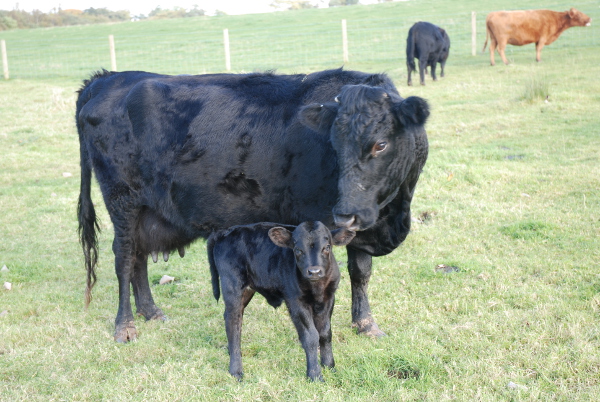
| <caption> | <caption> |
| Dexter mother and calf on a smallholding in Lanarkshire. | _Dexter mother and calf on a smallholding in Lanarkshire._ |
| </caption> | </caption> |
| |
| |
| |
| ## What are the benefits of keeping cattle? | ===== What are the benefits of keeping cattle? ===== |
| |
| - traditional / rare breeds are usually easier to manage, with less to go wrong; they tend to be hardier, can be outside all year, and breed for longer (Belgian Blues commonly breed for 7 years, Dexters for 15) | - traditional / rare breeds are usually easier to manage, with less to go wrong; they tend to be hardier, can be outside all year, and breed for longer (Belgian Blues commonly breed for 7 years, Dexters for 15) |
| <figure> | <figure> |
| |
| {{url>https://www.youtube.com/embed/csgfsIlhd6U 560,315}} | {{url>https://www.youtube.com/embed/csgfsIlhd6U}} |
| |
| <caption> | <caption> |
| South Devon, North Devon, Angus, Simmental and Belgian Blue cattle on an organic beef farm near Bristol | _South Devon, North Devon, Angus, Simmental and Belgian Blue cattle on an organic beef farm near Bristol_ |
| |
| </caption> | </caption> |
| |
| |
| ## What can I do? | ===== What can I do? ===== |
| |
| **Preparation:** cattle are big animals and therefore need space, but they don’t require much work. Make sure you have storage space for hay. It’s cheaper to buy hay in bulk straight off the field and store it yourself, than to buy it after it’s been stored somewhere else. If you have the shelter of trees and [hedges](http://lowimpactorg.onyx-sites.io/categories/hedges), you don’t necessarily need a shed, but if you don’t, you can build a 3-sided shed for them to find shelter from the worst weather. You’ll need a trailer or a friendly local farmer / smallholders’ group to borrow one from. Find one of these groups first if you can, and go and see cattle kept on a small scale, or go [WWOOFing](http://lowimpactorg.onyx-sites.io/categories/wwoofing) on a farm or smallholding that has cattle. | **Preparation:** cattle are big animals and therefore need space, but they don’t require much work. Make sure you have storage space for hay. It’s cheaper to buy hay in bulk straight off the field and store it yourself, than to buy it after it’s been stored somewhere else. If you have the shelter of trees and [hedges](/hedg/hedges), you don’t necessarily need a shed, but if you don’t, you can build a 3-sided shed for them to find shelter from the worst weather. You’ll need a trailer or a friendly local farmer / smallholders’ group to borrow one from. Find one of these groups first if you can, and go and see cattle kept on a small scale, or go [WWOOFing](/wwoo/wwoofing) on a farm or smallholding that has cattle. |
| |
| <WRAP center centeralign> | <WRAP center centeralign> |
| |
| <caption> | <caption> |
| Zebu cattle are a popular dairy breed in Africa and Asia. | _Zebu cattle are a popular dairy breed in Africa and Asia._ |
| |
| </caption> | </caption> |
| |
| <caption> | <caption> |
| Smallholder showing a chequebook-style cattle passport (left) – which changed to a single page document (right) for all animals born since 1 August 2011. | _Smallholder showing a chequebook-style cattle passport (left) – which changed to a single page document (right) for all animals born since 1 August 2011._ |
| |
| </caption> | </caption> |
| </WRAP> | </WRAP> |
| |
| **Meat:** legally, cattle can be [slaughtered for home consumption](https://www.food.gov.uk/safety-hygiene/home-slaughter-of-livestock) but the current TSE regulations often make this impractical so it is easier if they are taken to an approved abattoir; but you may be able to do your own [butchery](http://lowimpactorg.onyx-sites.io/categories/butchery). Find a local friendly abattoir – they’ll be used to large farmers, but could fit you in with individual beasts. If you want to sell the meat, you have to have your premises inspected by your local Environmental Health dept. (it doesn’t have to be all stainless steel – just clean), and you have to have approved labelling. From a decent-sized cow you could expect to get 3-400kg of meat. You’d need a refrigerated van to get your meat home from the abattoir, but again you could borrow one from a friendly farmer / smallholders’ group. | **Meat:** legally, cattle can be [slaughtered for home consumption](https://www.food.gov.uk/safety-hygiene/home-slaughter-of-livestock) but the current TSE regulations often make this impractical so it is easier if they are taken to an approved abattoir; but you may be able to do your own [butchery](/butc/butchery). Find a local friendly abattoir – they’ll be used to large farmers, but could fit you in with individual beasts. If you want to sell the meat, you have to have your premises inspected by your local Environmental Health dept. (it doesn’t have to be all stainless steel – just clean), and you have to have approved labelling. From a decent-sized cow you could expect to get 3-400kg of meat. You’d need a refrigerated van to get your meat home from the abattoir, but again you could borrow one from a friendly farmer / smallholders’ group. |
| |
| **Dairy:** see [here](http://lowimpactorg.onyx-sites.io/categories/dairying). | **Dairy:** see [here](/dair/dairying). |
| |
| <WRAP center centeralign> | <WRAP center centeralign> |
| |
| <caption> | <caption> |
| Linocut print of a Dexter. | _Linocut print of a Dexter._ |
| |
| </caption> | </caption> |
| |
| <caption> | <caption> |
| Belted Galloway - another hardy, Scottish breed good for smallholders. | _Belted Galloway - another hardy, Scottish breed good for smallholders._ |
| |
| </caption> | </caption> |
| <figure> | <figure> |
| |
| {{url>https://www.youtube.com/embed/8zOLTji6M0A 560,315}} | {{url>https://www.youtube.com/embed/8zOLTji6M0A}} |
| |
| <caption> | <caption> |
| Reasons that Dexters make the ideal family / smallholder cow | _Reasons that Dexters make the ideal family / smallholder cow_ |
| |
| </caption> | </caption> |
| |
| |
| ## Further resources | ===== Forum ===== |
| |
| | This topic belongs to the section [[gt:gardening|Gardening, smallholding & farming]]. You can ask questions or add information on the corresponding [Forum section](https://forum.growingthecommons.org/t/gardening). |
| |
| ## Specialist(s) | ===== Further resources ===== |
| |
| **Thanks to Robert Rose of [Rosewood Farm](http://www.rosewood.farm/) for information.** | - [Gov.uk](https://www.gov.uk/government/publications/code-of-recommendations-for-the-welfare-of-livestock-cattle) - welfare of beef and dairy cattle |
| | - [HSE](https://www.hse.gov.uk/pubns/ais35.pdf) - handling and housing cattle |
| | - [Organic Livestock Marketing Co-op](https://www.olmc.co.uk/) |
| | - [Raising your own beef for your family](https://www.backwoodshome.com/raising-your-own-beef-for-your-family/) |
| | - [British Cattle Veterinary Association](https://www.bcva.org.uk/) |
| | - [Cattle breeds](https://cattleinternationalseries.weebly.com/) |
| |
| |
|  | |
| |
| Robert Rose, fuelled by a life-long passion for cattle & grasslands, is on a mission to produce genuinely sustainable food from the most important floodplain meadow landscape remaining in the UK. Today we provide holistic grazing services to farmers & wildlife conservation organisations, and [Rosewood Farm](http://www.Rosewood.Farm "Rosewood Farm") delivers wildlife-friendly beef direct to health & environmentally conscious consumers throughout the UK by mail order. | ===== Related topics ===== |
| |
| | - [Cheesemaking](chee:cheesemaking) |
| | - [Smallholding](smho:smallholding) |
| | - [Keeping livestock](livs:livestock) |
| | - [Leatherwork](leat:leatherwork) |
| | - [Dairying](dair:dairying) |
| | - [Meadows, grass & pasture](mdws:meadows) |
| | - [Skins & hides](skin:skins) |
| | - [Fences](fenc:fences) |
| | - [Hedges](hedg:hedges) |
| | - [Butchery & meat](butc:butchery) |
| | - [Biogas](biog:biogas) |
| |
| | ===== Specialist curators of this topic ===== |
| |
| _Date on Lowimpact:2013-11-26_ | |
| |