| Both sides previous revision Previous revision Next revision | Previous revision |
| ecoc:eco_carbon_footprints [2026/03/10 12:38] – external edit 127.0.0.1 | ecoc:eco_carbon_footprints [2026/08/19 00:24] (current) – external edit 127.0.0.1 |
|---|
| # Eco & carbon footprints | This topic is part of [[gt:learning|Learning & personal development]] and [[gt:wellbeing|Wellbeing, home & relationships]]. |
| | ====== Eco & carbon footprints ====== |
| |
| |
| |
| |
| ## What are eco & carbon footprints? | ===== What are eco & carbon footprints? ===== |
| |
| They’re tools to help calculate the impact that humans are having on nature. They can give us a rough idea as to whether our way of life is sustainable or not. | They’re tools to help calculate the impact that humans are having on nature. They can give us a rough idea as to whether our way of life is sustainable or not. |
| |
| Humanity’s footprint represents our demands on the Earth versus its ability to supply what we need. This ability is known as biological capacity or ‘biocapacity’ (see below). | Humanity’s footprint represents our demands on the Earth versus its ability to supply what we need. This ability is known as biological capacity or ‘biocapacity’ (see below). |
| |
| > ### Biocapacity | > ### Biocapacity |
| > | > |
| An ecological footprint differs from a [carbon footprint](https://en.wikipedia.org/wiki/Carbon_footprint) in that the latter is a measure of greenhouse gas production, while the former is concerned with the total impact of our activities. Therefore, your ecological footprint includes your carbon footprint, along with other measures of natural resource use (water, soil, energy, food, fibre, timber, minerals, etc.) and waste. Your carbon footprint is almost entirely down to the amount of fossil fuels you are responsible for burning (plus a component linked to the amount of biomass you are responsible for removing), to provide your consumption and deal with your waste. | An ecological footprint differs from a [carbon footprint](https://en.wikipedia.org/wiki/Carbon_footprint) in that the latter is a measure of greenhouse gas production, while the former is concerned with the total impact of our activities. Therefore, your ecological footprint includes your carbon footprint, along with other measures of natural resource use (water, soil, energy, food, fibre, timber, minerals, etc.) and waste. Your carbon footprint is almost entirely down to the amount of fossil fuels you are responsible for burning (plus a component linked to the amount of biomass you are responsible for removing), to provide your consumption and deal with your waste. |
| |
| ### History | ==== History ==== |
| |
| The term ‘ecological footprint’ was coined in the early '90s by Mathis Wackernagel and William Rees at the University of British Columbia, who founded the [Global Footprint Network](https://www.footprintnetwork.org/). The concept was later used by the [Worldwide Fund for Nature (WWF)](https://support.wwf.org.uk/) in their ‘Best Foot Forward’ campaign and continues to be used today by scientists, businesses, governments, individuals and institutions that monitor our use of ecological resources and work towards sustainable development. \[NB: WWF have now distanced themselves from the ecological footprint measurement and concentrate more on carbon footprints, which are easier to measure and better understood by the public. They also recommend using a basket of indicators, such as those provided by the [UN System of Environmental and Economic Accounting](https://seea.un.org/), and [Sustainable Development Goals](https://www.un.org/sustainabledevelopment/sustainable-development-goals/).\] | The term ‘ecological footprint’ was coined in the early '90s by Mathis Wackernagel and William Rees at the University of British Columbia, who founded the [Global Footprint Network](https://www.footprintnetwork.org/). The concept was later used by the [Worldwide Fund for Nature (WWF)](https://support.wwf.org.uk/) in their ‘Best Foot Forward’ campaign and continues to be used today by scientists, businesses, governments, individuals and institutions that monitor our use of ecological resources and work towards sustainable development. \[NB: WWF have now distanced themselves from the ecological footprint measurement and concentrate more on carbon footprints, which are easier to measure and better understood by the public. They also recommend using a basket of indicators, such as those provided by the [UN System of Environmental and Economic Accounting](https://seea.un.org/), and [Sustainable Development Goals](https://www.un.org/sustainabledevelopment/sustainable-development-goals/).\] |
| <figure> | <figure> |
| |
| {{url>https://www.youtube.com/embed/B8Iw0TH2czQ 560,315}} | {{url>https://www.youtube.com/embed/B8Iw0TH2czQ}} |
| |
| <caption> | <caption> |
| |
| |
| ## What are the benefits of eco & carbon footprints? | ===== What are the benefits of eco & carbon footprints? ===== |
| |
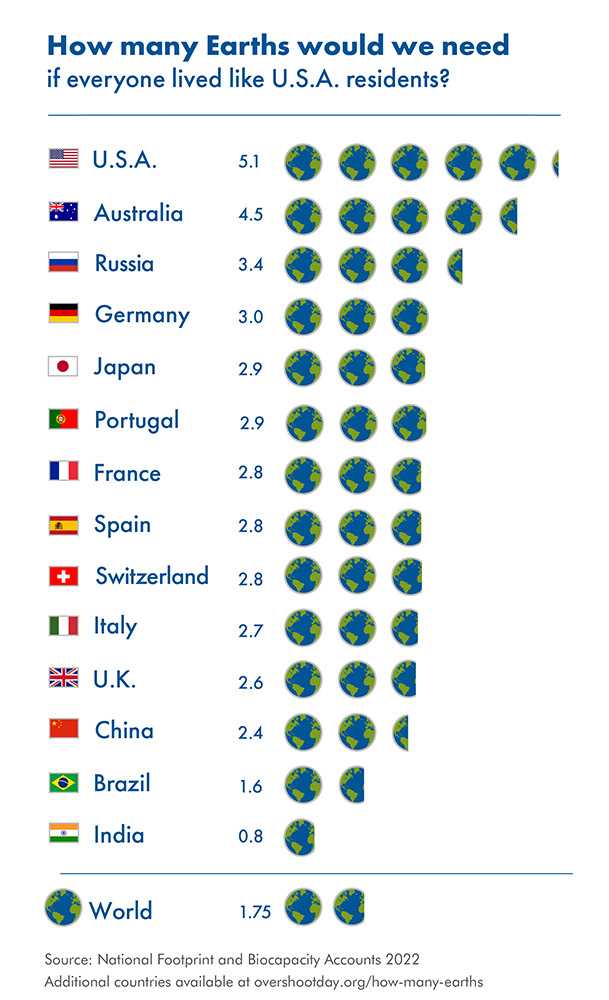
| They make it very clear whether the way we live is sustainable or not. Lowimpact.org is all about reducing our impact on nature – but before the ‘footprint’ concept was developed, it was very difficult to work out what our individual or collective impact actually was. | They make it very clear whether the way we live is sustainable or not. Lowimpact.org is all about reducing our impact on nature – but before the ‘footprint’ concept was developed, it was very difficult to work out what our individual or collective impact actually was. |
| <figure> | <figure> |
| |
|  |  |
| |
| <caption> | |
| _https://www.overshootday.org/how-many-earths-or-countries-do-we-need/_ | |
| |
| </caption> | |
| |
| </figure> | </figure> |
| |
| |
| ## What can I do? | ===== What can I do? ===== |
| |
| In a nutshell, make sure that your footprint is less than one planet. | In a nutshell, make sure that your footprint is less than one planet. |
| <figure> | <figure> |
| |
| {{url>https://www.youtube.com/embed/jXCZ9MFBBp4 560,315}} | {{url>https://www.youtube.com/embed/jXCZ9MFBBp4}} |
| |
| <caption> | <caption> |
| |
| |
| ## Further resources | ===== Forum ===== |
| | |
| | This topic belongs to the section [[gt:learning|Learning & personal development]]. You can ask questions or add information on the corresponding [Forum section](https://forum.growingthecommons.org/t/learning). |
| | |
| | It is also in the section [[gt:wellbeing|Wellbeing, home & relationships]] (Forum: [Wellbeing, home & relationships](https://forum.growingthecommons.org/t/wellbeing)). |
| | |
| | ===== Further resources ===== |
| |
| - [Earth Overshoot Day](https://overshoot.footprintnetwork.org/) | - [Earth Overshoot Day](https://overshoot.footprintnetwork.org/) |
| |
| |
| ## Related topics | ===== Related topics ===== |
| |
| | - [Downshifting](down:downshifting) |
| | - [Low-impact living](lilv:living) |
| | - [Personal development](pers:personal_development) |
| | - [The nature problem](ntre:nature) |
| |
| ## Specialist curators of this topic | ===== Specialist curators of this topic ===== |
| |
| |