| Both sides previous revision Previous revision Next revision | Previous revision |
| coec:commons_economy [2025/11/29 15:30] – asimong | coec:commons_economy [2026/02/11 14:20] (current) – [Specialist curators of this topic] katja |
|---|
| *Part of [Commons Economy & Exchange](cats:ctee)* | # Commons economy |
| |
| # Commons Economy | |
| |
|  |  |
| | |
| | --- |
| |
| > "You never change things by fighting the existing reality. To change something, build a new model that makes the existing model obsolete." - Buckminster Fuller | > "You never change things by fighting the existing reality. To change something, build a new model that makes the existing model obsolete." - Buckminster Fuller |
| > | > |
| > "People who are directly affected by and have to live with a resource are more likely to manage that resource sustainably." - Elinor Ostrom | > "People who are directly affected by and have to live with a resource are more likely to manage that resource sustainably." - Elinor Ostrom |
| | |
| |
| |
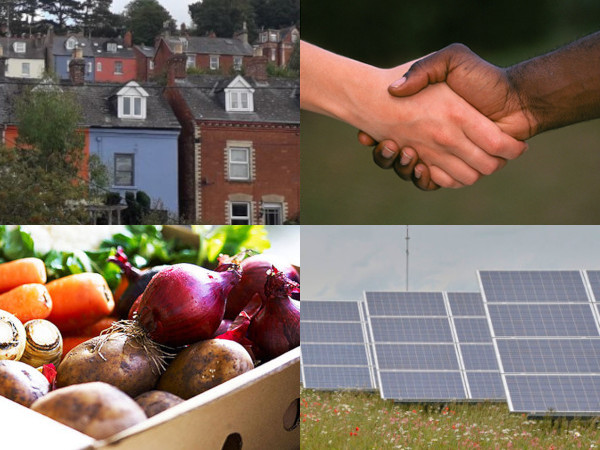
| It’s an economy in which the essentials of life – housing, energy, land, food, water, transport, social care, the means of exchange etc. are owned in common, in communities, rather than by absentee landlords, corporations or the state. Commons have 3 parts: | It’s an economy in which the essentials of life – housing, energy, land, food, water, transport, social care, the means of exchange etc. are owned in common, in communities, rather than by absentee landlords, corporations or the state. Commons have 3 parts: |
| |
| * Resources / assets | - Resources / assets |
| * ‘Commoners’ – local people who control and use those resources | |
| * A set of rules, written by the commoners, so that the resources are not lost, by being sold or used up. | - ‘Commoners’ – local people who control and use those resources |
| | |
| | - A set of rules, written by the commoners, so that the resources are not lost, by being sold or used up. |
| |
| We believe that a combination of the inherent social nature of humans, ancient commons practices, established commons principles and new commons ideas can help build a commons movement to challenge the current economy in a way that nothing else has or can. | We believe that a combination of the inherent social nature of humans, ancient commons practices, established commons principles and new commons ideas can help build a commons movement to challenge the current economy in a way that nothing else has or can. |
| You may have heard of [Garrett Hardin](https://en.wikipedia.org/wiki/Garrett_Hardin)'s famous essay, _the Tragedy of the Commons_, in which he claimed that commons will always fail because of incentives for all users of a common resource to take a little more than their fair share until the resource collapses. [Elinor Ostrom](https://en.wikipedia.org/wiki/Elinor_Ostrom) pointed out that Hardin was talking about a free-for-all, not a commons - for which she received a Nobel Prize. She shows that communities can develop systems of self-governance to manage resources without the need for top-down government intervention or privatization. | You may have heard of [Garrett Hardin](https://en.wikipedia.org/wiki/Garrett_Hardin)'s famous essay, _the Tragedy of the Commons_, in which he claimed that commons will always fail because of incentives for all users of a common resource to take a little more than their fair share until the resource collapses. [Elinor Ostrom](https://en.wikipedia.org/wiki/Elinor_Ostrom) pointed out that Hardin was talking about a free-for-all, not a commons - for which she received a Nobel Prize. She shows that communities can develop systems of self-governance to manage resources without the need for top-down government intervention or privatization. |
| |
| <WRAP center> | <WRAP center centeralign> |
| <figure> | <figure> |
|  | |
| <caption>*Elinor Ostrom, whose work made it clear that commoning is not about a ‘free-for-all’, but responsible governance of resources. Image: [Holger Motzkau](https://commons.wikimedia.org/wiki/User:Prolineserver), [CC-by-SA-3.0](https://creativecommons.org/licenses/by-sa/3.0/).*</caption> |  |
| | |
| | <caption> |
| | _Elinor Ostrom, whose work made it clear that commoning is not about a ‘free-for-all’, but responsible governance of resources. Image: [Holger Motzkau](https://commons.wikimedia.org/wiki/User:Prolineserver), [CC-by-SA-3.0](https://creativecommons.org/licenses/by-sa/3.0/)._ |
| | </caption> |
| </figure> | </figure> |
| </WRAP> | </WRAP> |
| ### Ostrom’s commons principles | ### Ostrom’s commons principles |
| |
| 1. **Clearly defined boundaries:** commoners understand what resources they have responsibility for, and who with. | 1. **Clearly defined boundaries:** commoners understand what resources they have responsibility for, and who with. |
| 2. **Regulations correspond to the needs and conditions of the community:** commoners understand the relationship between contribution and benefits. | |
| 3. **Collective decision-making:** individuals affected by the regulations can participate in changing the regulations. | |
| 4. **Monitoring:** commoners monitor and re-assess the rules / commitments themselves, or appoint others, drawn from, or accountable to the commoners who ensure they’re adhered to. | |
| 5. **Graduated sanctions:** commoners design sanctions for violations of rules / commitments, depending on the severity of the violation. | |
| 6. **Conflict resolution:** commoners devise conflict-resolution mechanisms that are low cost and easily accessible for all members. | |
| 7. **Local autonomy:** commoners can create regulations and institutions without the infringement of an outside authority. | |
| 8. **Nested groups:** if part of larger systems, commons groups are organised in multiple layers of nested groups. | |
| |
| <WRAP center> | 3. **Regulations correspond to the needs and conditions of the community:** commoners understand the relationship between contribution and benefits. |
| | |
| | 5. **Collective decision-making:** individuals affected by the regulations can participate in changing the regulations. |
| | |
| | 7. **Monitoring:** commoners monitor and re-assess the rules / commitments themselves, or appoint others, drawn from, or accountable to the commoners who ensure they’re adhered to. |
| | |
| | 9. **Graduated sanctions:** commoners design sanctions for violations of rules / commitments, depending on the severity of the violation. |
| | |
| | 11. **Conflict resolution:** commoners devise conflict-resolution mechanisms that are low cost and easily accessible for all members. |
| | |
| | 13. **Local autonomy:** commoners can create regulations and institutions without the infringement of an outside authority. |
| | |
| | 15. **Nested groups:** if part of larger systems, commons groups are organised in multiple layers of nested groups. |
| | |
| | <WRAP center centeralign> |
| <figure> | <figure> |
|  | |
| <caption>//Cattle have been grazed on managed alpine meadow commons in Switzerland for hundreds of years without depleting the resource. Pic: [Richard Bartz](https://commons.wikimedia.org/wiki/File:Bos_taurus_taurus_sideview_2.jpg), [CC BY-SA 2.5](https://creativecommons.org/licenses/by-sa/2.5)// |  |
| | |
| | <caption> |
| | _Cattle have been grazed on managed alpine meadow commons in Switzerland for hundreds of years without depleting the resource. Pic: [Richard Bartz](https://commons.wikimedia.org/wiki/File:Bos_taurus_taurus_sideview_2.jpg), [CC BY-SA 2.5](https://creativecommons.org/licenses/by-sa/2.5)_ |
| </caption> | </caption> |
| | |
| </figure> | </figure> |
| </WRAP> | </WRAP> |
| There are new tools and ideas that allow us to: | There are new tools and ideas that allow us to: |
| |
| 1. **bring assets into the commons without debt:** by issuing [vouchers](https://www.lowimpact.org/categories/use-credit-obligations) sold at a discount. Imagine an energy group wanting to put up a wind turbine. At the moment, they’d need to go into debt or give away equity, which means the infrastructure will be in the hands of capitalists before long (like many co-ops and building societies). Instead, they issue energy vouchers, denominated in kWh, not £ (which makes them inflation-proof). People will want them because they’re sold at a discount, and they provide a store of value – interest-free security for old age or sickness. This basic idea can work in every sector of the economy, and vouchers could form the basis of a pension, based in communities and separate from the finance system. | 1. **bring assets into the commons without debt:** by issuing [vouchers](/ucos/Use-credit_obligations) sold at a discount. Imagine an energy group wanting to put up a wind turbine. At the moment, they’d need to go into debt or give away equity, which means the infrastructure will be in the hands of capitalists before long (like many co-ops and building societies). Instead, they issue energy vouchers, denominated in kWh, not £ (which makes them inflation-proof). People will want them because they’re sold at a discount, and they provide a store of value – interest-free security for old age or sickness. This basic idea can work in every sector of the economy, and vouchers could form the basis of a pension, based in communities and separate from the finance system. |
| 2. **provide strong asset locks:** to prevent appropriation of commons assets. Commons groups have different member types: users / customers, investors, stewards (employees), but also a ‘custodian’ member class (a bit like trusted 'village elders'), who have a veto vote to make sure that commons principles are not violated. | |
| 3. **reduce the need for money, banks and interest:** by ‘[credit clearing](https://www.lowimpact.org/categories/credit-clearing)’. It’s something the banks do, to reduce the need for cash to pay debts. But we can do it too. Imagine A owes B £10; B owes C £10; C owes A £10. If everyone has all the information, it can just clear, without needing money to pay debts. For networks of trading small businesses, this can be done with algorithms, covering large areas. | |
| 4. **remove the need for money entirely within trading networks:** within those large areas, smaller clusters of businesses will trade with each other regularly. They can share a ‘[mutual credit](https://www.lowimpact.org/categories/mutual-credit)’ ledger in which members get an account (with numbers, but not money), set at zero. When they sell, their numbers go up. When they buy, they go down. There are limits to how far anyone can go into credit or debit. It’s just an accounting system, for who’s done what for whom – no money required, so nothing to extract from communities. | |
| 5. **federate to form the basis of a new, commons economy:** all commons projects can be connected together via the ‘[Credit Commons Protocol](https://www.lowimpact.org/categories/economy/credit-commons/)’ – a ‘language’ that they can all speak that allows them to trade between each other – but in a federation, with no centre. Each local group retains full autonomy. Everything is interoperable – so people could eventually pay for their housing, energy, care, shopping, and receive wages etc. in mutual credit. | |
| |
| <WRAP center> | 3. **provide strong asset locks:** to prevent appropriation of commons assets. Commons groups have different member types: users / customers, investors, stewards (employees), but also a ‘custodian’ member class (a bit like trusted 'village elders'), who have a veto vote to make sure that commons principles are not violated. |
| | |
| | 5. **reduce the need for money, banks and interest:** by ‘[credit clearing](/crcl/credit_clearing)’. It’s something the banks do, to reduce the need for cash to pay debts. But we can do it too. Imagine A owes B £10; B owes C £10; C owes A £10. If everyone has all the information, it can just clear, without needing money to pay debts. For networks of trading small businesses, this can be done with algorithms, covering large areas. |
| | |
| | 7. **remove the need for money entirely within trading networks:** within those large areas, smaller clusters of businesses will trade with each other regularly. They can share a ‘[mutual credit](/mucr/mutual_credit)’ ledger in which members get an account (with numbers, but not money), set at zero. When they sell, their numbers go up. When they buy, they go down. There are limits to how far anyone can go into credit or debit. It’s just an accounting system, for who’s done what for whom – no money required, so nothing to extract from communities. |
| | |
| | 9. **federate to form the basis of a new, commons economy:** all commons projects can be connected together via the ‘[Credit Commons Protocol](/crco/credit_commons)’ – a ‘language’ that they can all speak that allows them to trade between each other – but in a federation, with no centre. Each local group retains full autonomy. Everything is interoperable – so people could eventually pay for their housing, energy, care, shopping, and receive wages etc. in mutual credit. |
| | |
| | <WRAP center centeralign> |
| <figure> | <figure> |
|  | |
| <caption>//In a commons economy, mutual credit is a tool for accounting for exchange, but it doesn’t provide a store of value. Future-use vouchers (a.k.a. ‘use-credit obligations’) can be used to save / store value / provide non-monetary pensions.// |  |
| | |
| | <caption> |
| | _In a commons economy, mutual credit is a tool for accounting for exchange, but it doesn’t provide a store of value. Future-use vouchers (a.k.a. ‘use-credit obligations’) can be used to save / store value / provide non-monetary pensions._ |
| </caption> | </caption> |
| | |
| </figure> | </figure> |
| </WRAP> | </WRAP> |
| [Local Loop Merseyside](https://localloop-merseyside.co.uk/) - building a city-wide credit clearing network in Liverpool that can be replicated in other cities. | [Local Loop Merseyside](https://localloop-merseyside.co.uk/) - building a city-wide credit clearing network in Liverpool that can be replicated in other cities. |
| |
| [Island Power](https://www.island-power.net/) are using the voucher concept to build renewable energy infrastructure for Pacific islands – but it’s also the basic idea behind air miles and [community-supported agriculture](https://www.lowimpact.org/categories/food/community-supported-agriculture/). | [Island Power](https://www.island-power.net/) are using the voucher concept to build renewable energy infrastructure for Pacific islands – but it’s also the basic idea behind air miles and [community-supported agriculture](/comy/community). |
| |
| [Mutual Credit Services](https://www.mutualcredit.services/) are designing and building commons models for all sectors of the economy. | [Mutual Credit Services](https://www.mutualcredit.services/) are designing and building commons models for all sectors of the economy. |
| |
| According to the [International Reciprocal Trade Association](https://www.irta.com/), around $12-14 billion worth of trade happens annually via mutual credit between participating businesses in their global network. There are similar networks in [Sardinia](https://www.sardexpay.net/) and [Kenya](https://www.lowimpact.org/posts/how-chamas-mutual-credit-changing-africa/). | According to the [International Reciprocal Trade Association](https://www.irta.com/), around $12-14 billion worth of trade happens annually via mutual credit between participating businesses in their global network. There are similar networks in [Sardinia](https://www.sardexpay.net/) and [Kenya](http://lowimpactorg.onyx-sites.io/posts/how-chamas-mutual-credit-changing-africa/). |
| |
| <WRAP center> | <WRAP center centeralign> |
| <figure> | <figure> |
| | |
|  |  |
| <caption>//Stroud Commons: inaugural event.// | |
| | <caption> |
| | _Stroud Commons: inaugural event._ |
| </caption> | </caption> |
| | |
| </figure> | </figure> |
| </WRAP> | </WRAP> |
| | |
| | |
| |
| ## What are the benefits of the commons economy? | ## What are the benefits of the commons economy? |
| Local economies are reoriented towards providing: | Local economies are reoriented towards providing: |
| |
| * goods and services for community members, rather than generating profits for shareholders. For example, housing exists to house people securely, not as investments for absentee landlords or corporations. | - goods and services for community members, rather than generating profits for shareholders. For example, housing exists to house people securely, not as investments for absentee landlords or corporations. |
| * more jobs, that are well-paid, secure, democratic, meaningful and interesting. | |
| * affordability. | |
| * personal attention from real people. | |
| |
| <WRAP center> | - more jobs, that are well-paid, secure, democratic, meaningful and interesting. |
| | |
| | - affordability. |
| | |
| | - personal attention from real people. |
| | |
| | <WRAP center centeralign> |
| <figure> | <figure> |
|  | |
| <caption>*An economy based on credit clearing, mutual credit and commons ownership would insulate local economies from wider financial downturns.*</caption> |  |
| | |
| | <caption> |
| | _An economy based on credit clearing, mutual credit and commons ownership would insulate local economies from wider financial downturns._ |
| | |
| | </caption> |
| </figure> | </figure> |
| </WRAP> | </WRAP> |
| |
| |
| ### Decentralising power away from corporations | ### Decentralising power away from corporations |
| People in communities (e.g. in Switzerland, Japan, Spain and the Philippines) where there are commons for irrigation, pasture, woodlands etc. have for centuries organised themselves to set and monitor rules, and sanction those breaking them. This has developed excellent organisational skills for community cohesion in times of shortage or hardship. | People in communities (e.g. in Switzerland, Japan, Spain and the Philippines) where there are commons for irrigation, pasture, woodlands etc. have for centuries organised themselves to set and monitor rules, and sanction those breaking them. This has developed excellent organisational skills for community cohesion in times of shortage or hardship. |
| |
| An economy based on credit clearing, mutual credit and commons ownership would insulate local economies from wider financial downturns. | _An economy based on credit clearing, mutual credit and commons ownership would insulate local economies from wider financial downturns._ |
| |
| Communities are strengthened and become safer, friendlier and more fun, and towns retain their character and uniqueness. | Communities are strengthened and become safer, friendlier and more fun, and towns retain their character and uniqueness. |
| ### Environment | ### Environment |
| |
| Unlike capitalism, a commons economy has short supply chains and no '[growth imperative](https://www.lowimpact.org/categories/economy/steady-state-economics/)' and therefore might just be able to provide the things we need without completely destroying the biosphere (again, unlike capitalism). Decisions can be made to protect nature, that the profit motive overrules in corporations. | Unlike capitalism, a commons economy has short supply chains and no '[growth imperative](/stea/steady-state_economics)' and therefore might just be able to provide the things we need without completely destroying the biosphere (again, unlike capitalism). Decisions can be made to protect nature, that the profit motive overrules in corporations. |
| |
| <WRAP center> | <WRAP center centeralign> |
| <figure> | <figure> |
|  | |
| <caption>//The commons economy generates more (and more meaningful) jobs, managing schemes and maintaining properties / infrastructure.// |  |
| | |
| | <caption> |
| | _The commons economy generates more (and more meaningful) jobs, managing schemes and maintaining properties / infrastructure._ |
| </caption> | </caption> |
| | |
| </figure> | </figure> |
| </WRAP> | </WRAP> |
| |
| | ## What can I do? |
| |
| ### What can I do? | If you live in or around Stroud, you can [contact Stroud Commons](https://stroudcommons.org/contact/) if you’d like to get involved – as a volunteer / commons builder, investor, customer or steward (employee to manage / maintain the commons). |
| | |
| If you live in or around Stroud, you | |
| can [contact Stroud Commons](https://stroudcommons.org/contact/) if you’d like to get involved – as a volunteer / commons builder, investor, customer or steward (employee to manage / maintain the commons). | |
| |
| If you're part of a small business in or near Liverpool, contact [Local Loop Merseyside](https://localloop-merseyside.co.uk/) to ask about joining their scheme. | If you're part of a small business in or near Liverpool, contact [Local Loop Merseyside](https://localloop-merseyside.co.uk/) to ask about joining their scheme. |
| |
| We’re also [talking with people](https://www.lowimpact.org/posts/helping-commons-groups-form-and-grow-in-stroud-and-other-towns-and-countries/) in several other towns around the UK, and in other countries, about building the commons in their communities, and we're producing toolkits to help them do it. [Contact us](https://www.lowimpact.org/about/contact/) if you might be interested in doing the same in your town, or if you have skills that could help the commons movement generally. | We’re also [talking with people](http://lowimpactorg.onyx-sites.io/posts/helping-commons-groups-form-and-grow-in-stroud-and-other-towns-and-countries/) in several other towns around the UK, and in other countries, about building the commons in their communities, and we're producing toolkits to help them do it. [Contact us](http://lowimpactorg.onyx-sites.io/about/contact/) if you might be interested in doing the same in your town, or if you have skills that could help the commons movement generally. |
| |
| Help the commons by not giving your money to corporations where possible - by self-provisioning ([see our range of topics](https://www.lowimpact.org/categories/)), and using non-corporate tools and institutions for the things you need, such as: | Help the commons by not giving your money to corporations where possible - by self-provisioning ([see our range of topics](http://lowimpactorg.onyx-sites.io/categories/)), and using non-corporate tools and institutions for the things you need, such as: |
| |
| * [co-ops](https://www.lowimpact.org/categories/economy/co-operatives/) (including [housing](https://www.lowimpact.org/categories/economy/housing-co-operatives/) and [platform co-ops](https://www.lowimpact.org/categories/economy/platform-co-ops/)) | - [co-ops](/coop/co-operatives) (including [housing](/coop/co-operatives) and [platform co-ops](/pltc/platform_co-ops)) |
| * [free/open source software](https://www.lowimpact.org/categories/economy/free-open-source/) | |
| * [building societies](https://www.lowimpact.org/categories/economy/building-societies/) or [credit unions](https://www.lowimpact.org/categories/economy/credit-unions/) | |
| * [community energy](https://www.lowimpact.org/categories/economy/community-energy/) | |
| * [community-supported agriculture](https://www.lowimpact.org/categories/economy/community-supported-agriculture/) | |
| * [community land trusts](https://www.lowimpact.org/categories/economy/community-land-trusts/) or [cohousing](https://www.lowimpact.org/categories/economy/cohousing/) | |
| * [independent media](https://www.lowimpact.org/categories/economy/independent-media/) | |
| * [local shops](https://www.lowimpact.org/categories/economy/low-impact-shopping/), [farmers' markets](https://www.lowimpact.org/categories/food/farmers-markets/) and [veg box schemes](https://www.lowimpact.org/categories/economy/veg-box-schemes/) | |
| |
| Subscribe to our newsletter for commons news; comment on the blog, or [send us an article](https://www.lowimpact.org/blog-article-social-media-policy/); and of course, please share this page with anyone you think might be interested. We’d like to invite everyone to be a commoner! | - [free/open source software](/foss/open_source) |
| |
| ## Further resources | - [building societies](/bsoc/building_societies) or [credit unions](/crun/credit_unions) |
| |
| * Elinor Ostrom's *[Governing the Commons](https://www.lowimpact.org/wp-content/uploads/ostrom_1990.pdf)* (pdf) | - [community energy](/comy/community) |
| * Here’s more about [‘commoning’](https://www.lowimpact.org/categories/commoning), [housing commons](https://www.lowimpact.org/categories/housing-commons), [energy commons](https://www.lowimpact.org/posts/how-to-build-an-energy-commons), [climbing commons](http://climbingcommons.org/), [friendly societies](https://www.lowimpact.org/posts/bear-ye-one-anothers-burdens-friendly-societies-for-social-welfare) (social care commons) and [here’s a longer article](https://www.lowimpact.org/posts/replacing-capitalism-the-why-what-how-and-who-of-growing-the-commons-economy) about the why, what, how and who of the commons economy. | |
| * [Credit commons](https://www.lowimpact.org/categories/economy/credit-commons/): the 'money system' for the commons economy | |
| |
| ## Specialist(s) | - [community-supported agriculture](/comy/community) |
| |
|  | - [community land trusts](/comy/community) or [cohousing](/coho/cohousing) |
| |
| Dil Green was an architect and builder for 30 years, working on projects from an extension to London’s Science Museum to an award-wining eco-surgery. He now works away at systemic leverage points around [Governance](https://docs.google.com/document/d/1Rn54TgAXbOa0aaijb7knQCfQiQxA12LfoEhNOlalW4A/edit?usp=sharing), Wisdom: [Pattern Language](http://PatternLanguage.Institute), and Economy: [](https://opencredit.network/)[Mutual Credit Services](https://mutualcredit.services/). He lives in Brixton, and blogs at [digital-anthropology](https://digital-anthropology.me/). | - [independent media](/indy/independent_media) |
| |
| --- | - [local shops](/lish/shopping), [farmers' markets](/farm/farmers_markets) and [veg box schemes](/vegb/veg_box_schemes) |
| | |
| | Subscribe to our newsletter for commons news; comment on the blog, or [send us an article](http://lowimpactorg.onyx-sites.io/blog-article-social-media-policy/); and of course, please share this page with anyone you think might be interested. We’d like to invite everyone to be a commoner! |
| | |
| | ## Further resources |
| | |
| | - Elinor Ostrom's _[Governing the Commons](http://lowimpactorg.onyx-sites.io/wp-content/uploads/ostrom_1990.pdf)_ (pdf) |
| | - Here’s more about [‘commoning’](/comg/commoning), [housing commons](/hoco/Housing_commons), [energy commons](http://lowimpactorg.onyx-sites.io/posts/how-to-build-an-energy-commons), [climbing commons](http://climbingcommons.org/), [friendly societies](http://lowimpactorg.onyx-sites.io/posts/bear-ye-one-anothers-burdens-friendly-societies-for-social-welfare) (social care commons) and [here’s a longer article](http://lowimpactorg.onyx-sites.io/posts/replacing-capitalism-the-why-what-how-and-who-of-growing-the-commons-economy) about the why, what, how and who of the commons economy. |
| | - [Credit commons](/crco/credit_commons): the 'money system' for the commons economy |
| | - [Island Power](https://www.island-power.net/) - smart accelerator for energy commons |
| | - [Mutual Credit Services](https://www.mutualcredit.services/home) - building commons models for different economic sectors |
| | - [https://stroudcommons.org/](https://stroudcommons.org/) - implementing commons models in Stroud |
| | |
| | ## Specialist curators of this topic |
| |
| [Original at Lowimpact.org](https://www.lowimpact.org/categories/economy/commons-economy/) | {{tag>[economy, commons, society]}} |